Reliance Industries LimitedReliance Intelligence · AI CloudConfidential — internal
GPU Cloud Billing Cockpit
Source documents · PDF and Word originals
Source documents
The three finished pieces behind everything in this app. Each is rendered as a page in the app and available here as the original document.
The Token Business — Commercial & Go-to-Market Strategy
61 pages · August 2026
The full written companion to this cockpit: the commercial thesis and right to win, the SKU and pricing architecture, both worked financial examples on the same fleet, the billing / metering / revenue-assurance operating model, the compute-futures hedging strategy, and the organization and 90-day plan.
Sovereign AI Commercial Blueprint — narrated briefing
Video · 16 min · 19 slides
The full strategy deck as a narrated video: every slide of the blueprint with the speaking script read over it, in sync — mandate, market context, the two commercial wrappers, GTM sequencing, unit economics, revenue assurance, hedging, scenarios, the org build and the first 90 days.
Token Economics — How It Works (narrated explainer)
Video · 9 min · 9 slides
A narrated walkthrough of token economics on one worked 8-GPU node: the two meters and who carries idle risk, the $11.23/node-hr cost floor, the $78.32 full-density arithmetic, the 14.3% breakeven and 21.5% crossover, the density ladder, the four margin levers and the meter-assignment rule for each fleet slice.
A board-ready PDF for the Office of the CEO: the month at a glance, the top four insights with commentary, value drivers and cluster ROI, and ranked next best actions. Built from the same closed-month data as the cockpit, so the narrative can never drift from the numbers.
· Executive summary
· Top 4 insights
· Value drivers & ROI
· Strategy & next best actions
User guide — full walkthrough
Printable · every page and all 17 tabs
A detailed walkthrough of the whole app: what each screen shows, element by element, how to read it, the formulas behind every number, and the decisions it supports — plus the monthly close routine, the pricing review and a question-to-tab routing table. Built to be printed or saved as a PDF.
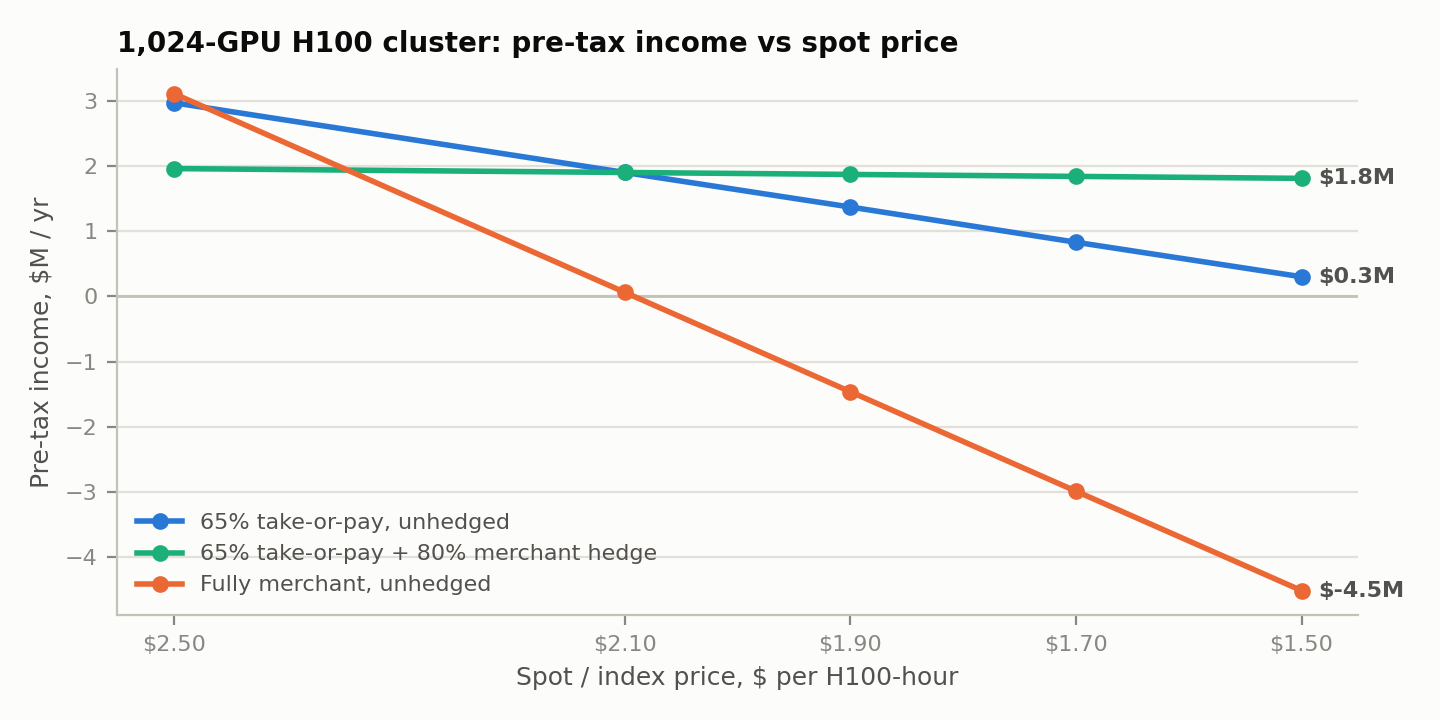
How to maximize gross margin and revenue-weighted utilization by optimizing four interacting levers rather than one rate card: the take-or-pay anchor, token multiplexing above the 21.3% crossover density, RL-priced residual capacity hedged at a $2.10 strike, and discount-waterfall governance.
· Cost floors: $0.485 / $1.495 / $1.899 per GPU-hr
How selling tokens differs from selling GPU-hours on identical hardware: the two meters and who carries idle risk, the worked 8-GPU reference node, the 14.3% cost breakeven and 21.5% reserved crossover, the density ladder from 20% to 80%, and which fleet slice belongs on which meter.
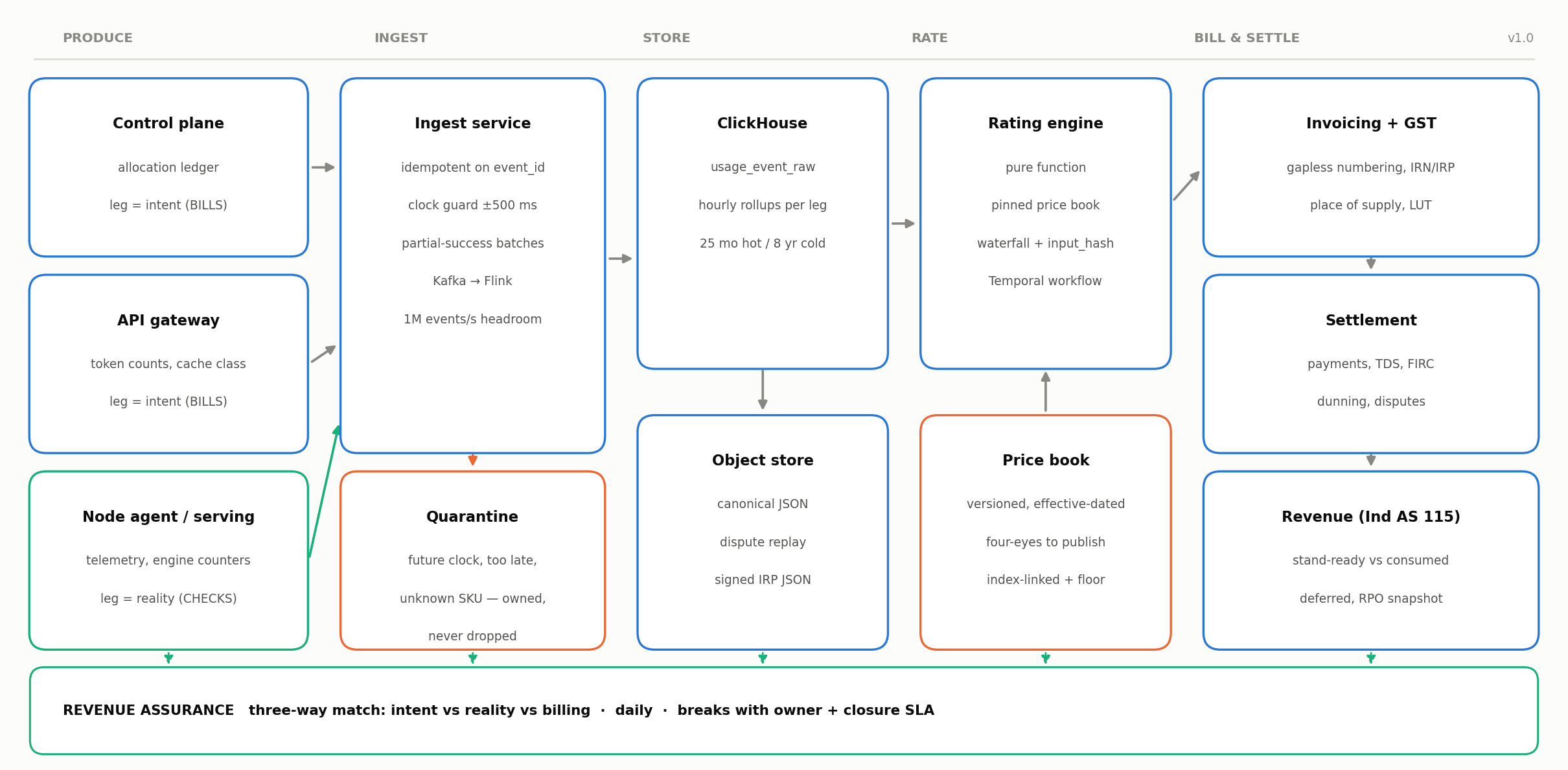
End-to-end P&L for the capacity and token businesses: pricing, metering, billing, settlement and revenue assurance, with two worked examples on the same fleet.
The two-leg metering architecture — capacity and token meters into one rating chain.Pre-tax income vs spot price across three hedging postures — the static form of the live model.
All figures are illustrative — synthetic data built from public benchmarks, consistent with each other but not any specific company's economics. The India tax and accounting treatments in the specification are engineering-facing summaries of published rules and need confirmation from a tax and statutory audit team before anything goes live.